

English version (translated by [email protected])
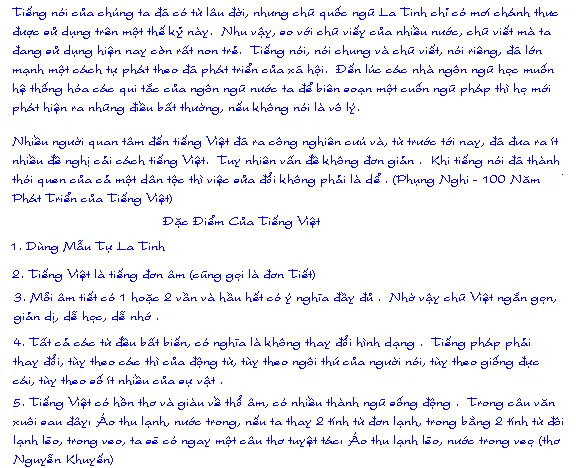
The vietnamese language has been in existence for at least a few millennia,
but its romanized version has only been in use for a little more than a
century. compared to other languages, it is quite young. the Vietnamese
language and its written form have since developed along with the Vietnamese
social evolution. Recently, during an effort to systematize the syntax of
the language, some vietnamese linguists have discovered several anomalies,
some of which may even be erroneous.
Linguistic scholars have researched this area and proposed ways to improve
the vietnamese language. However, it has proved anything but simple. The
language has evolved too far; it has become second nature to the vast
majority of the population, thus making any effort to change it very
challenging. (Phung nghi - 100 years in development of the Vietnamese
language)
Some characteristics of the vietnamese language
1. it utilizes the roman alphabets.
2. it is composed of monosyllabic words.
3. each syllable consists of 1 or 2 rhymes, most fully equipped with
meaning. vietnamese words are thus short and easy to learn and memorize.
4. the structure of each word is unchangeable, as opposed to most Western
languages which require modification of a particular word in accordance to,
for instance, who does it, how many are involved, when it is done, what sex
given to it, etc.,.
5. the vietnamese language may be said to embody poetry. it is capable of
bringing about the sounds and flavors of life. for instance, the following
prose:
ao lu.a la.nh, nu*o*c trong
(a cold silk shirt, clear water)
can be transformed into
ao lu.a la.nh le~o, nu*o*c trong veo (from a poem by nguyen Khuyen)
With the 2 monosyllabic words added, one can almost appreciate the coolness
of the silk and the clarity of the water.
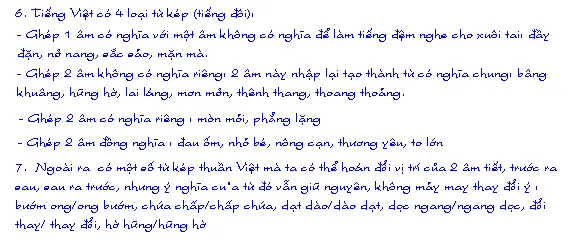
6. meaning of some words can be changed or enriched by adding other words.
there are 4 ways to combine words:
a. combining a meaningful word to a meaningless word for flow and/or
rhyme e.g., dda^`y dda(.n, no*? nang, sa(c sa?o, ma(.n ma`.)
b. combining 2 meaningless words to make something meaningful (e.g.,
ba^ng khua^ng, hu*~ng ho*`, lai lang, mo*n mo*?n, the^nh thang, thoang
thoa?ng.)
c. combining 2 words with independent meanings (e.g., mo`n mo?i, pha(?ng
la(.ng.)
d. combining 2 synonymous words (e.g., ddau o^m, nho? be, no^ng ca.n,
thu*o*ng ye^u, to lo*n.)
7. there are also some combined words which retain the same meaning even
after their order is switched (e.g., bu*o*m ong/ong bu*o*m, chu*a
cha^p/cha^p chu*a, da.t da`o/da`o da.t, do.c ngang/ngang do.c, ddo^?i
thay, thay do^?i, ho*` hu*~ng/hu*~ng ho*`.)
Many peoply have special interests on research and work on the language, for many years, have initiated ideas to make changes of the language. Unfortunately, the problem is not uncomplicated. when the language of spoken has been root or habbit of the whole nation communities the change is not easy (Phung Nghi-100 nam phat trien tieng Viet)
The characteristics of Vietnamese
_ use latin alphabet characters.
_ vietnamese is a single syllabel (also called mono-syllabel.)
_ every syllabel has 1 or 2 syllabels and most has meaningful. Therefore, vietnamese is short, simple, easy to learn, and easy to memorize (for most Vietnamese).
_ all syllabels are unchangeable. in other word, the words can not changed in appearance. the french must change depend on tense of verb, or by pronouns, the sex of objects, and depend on single or plural forms.
_ vietnamese language has sound of poetries and is rich in actions and mood of it own. it has number of idoms of adverb. Therefore, it's enriched with meaning and are easily can be translated into poems or poetries. for example, in the following script: "Ao thu lanh, nuoc trong" (means in the english literately--the chill of autum season, clean watter.) if we replace two adverds 'lanh' and 'trong' by two adverbs 'lanh leo' and 'trong veo', we will have a better in mood sentational poems: "Ao thu lanh leo, nuoc trong veo" ( could be translated as: "The chilly of Autum, the crystal water."--poem of khuyen Nguyen).
_ there are four possibilities of combination in vietnamese words.
* a syllabel which has a meaning with another which does not have any.
* both come together will make the sentence flow smoothly and enrich sound of sentence.
* two syllabels which do not have any meaning by itself, combine together will develop a common meaningful word.
* two meaningful words group into one phrase produce a new meaning.
* Last, two synonymous words group together to emphasize the meaning.
In Vietnamese, the possition of the two words could be swap around to enrich the sound of the sentence or the phrase. words can be palced in difference positions, like backward or forward either way, but the meaning is the same.
10/31/95 2:58 AM
translated by khanh pham
[email protected]
 Since 09/11/95